Garden133 Firmware: Deep Sleep and Auto-Discovery for ESP32 Sensors
Posted on August 9, 2025 • Last modified on August 15, 2026 • 6 min read • 1,236 words
Firmware Design for Low-Power, Self-Registering Sensor Units
The Garden133 system monitors garden soil moisture levels to assist with automated watering. Its firmware addresses two challenges fundamental to almost any outdoor sensor network: surviving on an extremely strict power budget, and automatically registering with a home automation platform.
This post covers how the firmware solves both challenges:
- Energy Conservation: Using deep sleep and RTC memory to stretch battery life on a solar-charged node.
- Self-Registration: Extending my
og31 C++ framework to relay satellite sensor metadata to the base station, which automatically publishes the entities to Home Assistant via MQTT Discovery.
The system uses two distinct firmware implementations: one for the satellite units in the yard, and one for the base station that acts as the indoor gateway to Home Assistant. The communication between them is handled over LoRa2 radios using the custom protocol detailed in the radio protocol post. If you are building an ESP32 project that needs to sleep outdoors and appear in your dashboard without manual entity configuration, the patterns and framework here are directly reusable.
Satellite Unit Firmware: Surviving on an Energy Budget
Integrating ESP32 Deep Sleep
The satellite units operate with a strict cycle: wake up, report soil conditions, and get back to sleep as quickly as possible to save power.
- They power on only long enough to sample sensors and fire off a LoRa packet.
- Then, they command the LoRa module to sleep.
- Finally, they set a timer for 5 minutes and drop the ESP32 into “deep sleep” mode.
When the ESP32 wakes from deep sleep, it’s essentially a fresh boot.
We can call the function esp_sleep_get_wakeup_cause() to see whether it is actually
booting or whether it has been awakened from deep sleep by a timer, an external signal, or
some other mechanism.
This article
from Random Nerd Tutorials provides a good explanation.
To keep track of things like the packet sequence number or the state of moisture filters
during deep sleep, we have to store data in a special section of memory marked with
RTC_DATA_ATTR.
This led to a particularly fun “learning opportunity” during development. I’m so used to initializing my variables that I reflexively added initializers to the RTC struct:
// This data should persist during deep sleep.
// DO NOT SET INITIALIZERS ON THESE VALUES!
RTC_DATA_ATTR struct {
  unsigned bootCount; // I initially wrote: unsigned bootCount = 0;
  byte mac[6];
  KernelFilter::State<kFilterSize> filter_state;
  // ...
} s_rtc;
It took me an embarrassing amount of time to realize that by adding = 0, I was telling
the bootloader to overwrite my saved data every time the board woke up.
Once I removed the initializers, the persistent memory finally started working.
Debug Mode: Making Garden133 Maintenance-Friendly
A device that sleeps for 299 out of every 300 seconds is hard to configure.
To solve this, I added a “Debug” toggle.
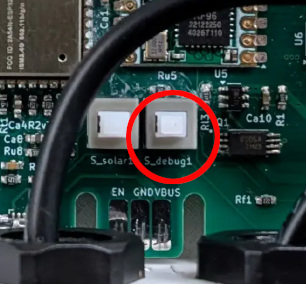
To reach the toggle, you do need to unscrew and open the sealed enclosure. However, when the toggle depressed, the firmware skips deep sleep and enables:
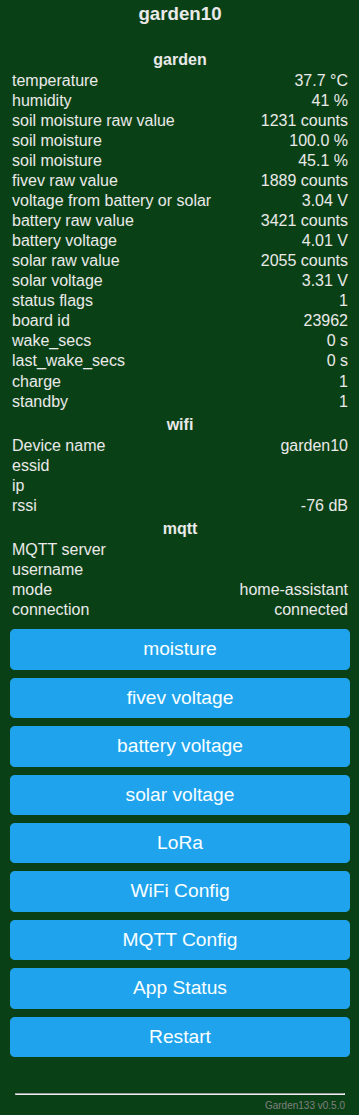
- WiFi & Web Interface: Allowing for configuration of WiFi, the moisture sensor, the LoRa radio, and MQTT.3
- Over-the-Air (OTA) Updates: So I can fix bugs without removing the PCB and attaching a serial cable.
Base Station Firmware: The LoRa-to-MQTT Gateway
While the satellites are optimized to run only briefly before sleeping, the base station is a permanent resident of the house with its own USB power supply, so it is always running. Its job is to listen for the satellites’ LoRa packets and translate them into a language Home Assistant understands. Garden133 Radio details the content and format of these packets.
Using the og3x-satellite library, the base station automatically implements the Home Assistant MQTT Discovery protocol on behalf of satellite units. This means that as soon as I deploy a new sensor, it automatically appears in my dashboard with all its entities pre-configured.
An example from the soil moisture sensor reading of the sensor for the satellite unit
monitoring our “Raised bed #1” is shown below.
It is sent to MQTT topic
homeassistant/sensor/lora133b/raised-bed-1_soil_moisture/config.
{
  "~": "og3/lora133b",
  "avty_t": "~/connection",
  "pl_avail": "online",
  "pl_not_avail": "offline",
  "device": {
    "name": "raised-bed-1",
    "ids": "raised-bed-1_5db6",
    "mf": "c133 org",
    "mdl": "LoRa133",
    "sw": "LoRa133 v0.5.0",
    "via_device": "8813BF012878_LoRa133",
  },
  "unit_of_meas": "%",
  "stat_t": "~/raised-bed-1_5db6",
  "val_tpl": "{{value_json.soil_moisture|float|round(1)}}",
  "dev_cla": "moisture",
  "name": "soil_moisture",
  "uniq_id": "raised-bed-1_5db6_soil_moisture",
  "state_class": "measurement"
}
With an entry like this for each sensor in the device, the device is automatically added to Home Assistant.
When a LoRa packet from this satellite unit with sensor reading values is received by the base
station, it is translated to a packet like this sent to topic
og3/lora133b/raised-bed-1_5db6:
{
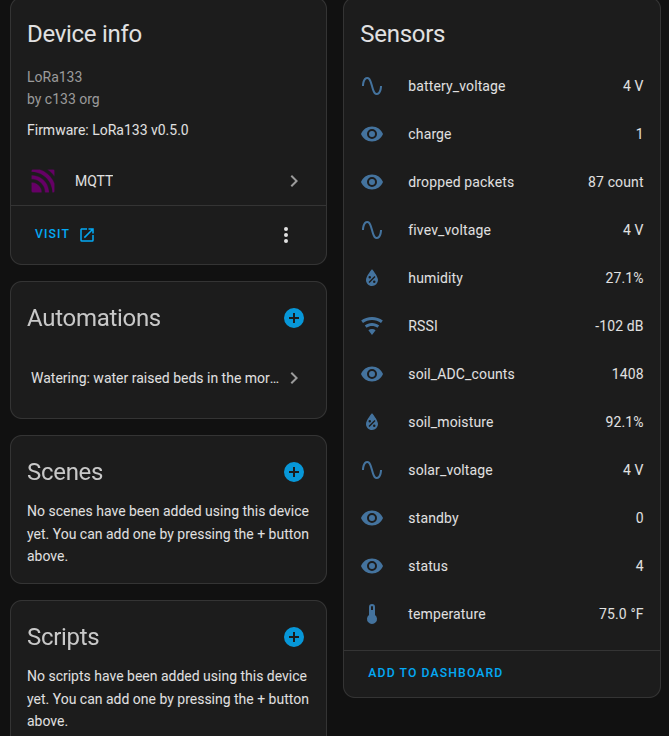
  "dropped_packets": 87,
  "RSSI": -102,
  "temperature": 23.85,
  "humidity": 27.06,
  "soil_moisture": 92.09239,
  "fivev_voltage": 3.992871,
  "solar_voltage": 3.876855,
  "soil_ADC_counts": 1408,
  "status": 4,
  "charge": 1,
  "standby": 0,
  "battery_voltage": 4.100391
}
Here is the Home Assistant device view after this message was parsed.
Modular C++ with the og3 Framework
I wrote the firmware for these devices using my og3 library.
Here, “og” stands for
original gangsta
because
it is an old-school C++ library and application framework, not one of those trendy
YAML
-based
frameworks like
ESPHome
that the kids these days are using.
This is partly because I want the control that writing firmware directly in C++ provides, and
partly because I’m a programmer so my hobby projects involve real programming, dammit!
In og3, code is organized into
Modules
.
Each module (WiFi, MQTT, Sensors) has a defined lifecycle:
link(), init(), start(), and update().
This allows me to build complex dependencies, like a web server that only starts once
WiFi is confirmed, without creating a spaghetti-style main loop.
graph LR
   B[Config] --> A[Flash]
   C[Wifi manager] --> B
   D[MQTT manager] --> C
   E[HA discovery] --> D
   F[Web server] --> C
   G[OTA manager] --> C
A simplified version of the satellite unit’s main loop demonstrates this modularity. It waits for the LoRa module to be ready, sends a single packet, and then uses a task scheduler to trigger the next sleep cycle.
void loop() {
  og3::s_app.loop(); // The og3 framework handles the module updates

  // If we aren't in debug mode, send our data once.
  if (!og3::s_is_debug_mode && og3::s_lora.is_ok()) {
    static bool s_sent = false;
    if (!s_sent) {
      og3::s_packet_sender.update();
      s_sent = true;
    }

    // After the radio has finished sending the data, just once,
    //  schedule the board to go into deep sleep.
    static bool s_sleep_started = false;
    if (!og3::s_packet_sender.is_sending() && !s_sleep_started) {
      og3::s_app.tasks().runIn(og3::kMsecInSec, og3::start_sleep);
      s_sleep_started = true;
    }
  }
}
Conclusion
The firmware for Garden133 is based on the same og3 framework that holds my other projects
together.
However, it adds power management, LoRa radio, and a satellite communication architecture.
The complete firmware is available at GitHub under the MIT license.
- Satellite unit: Garden133 GitHub repository .
- Base station: LoRa133 GitHub repository .
These both depend on the following libraries:
- Application framework:
og3. - Satellite communication architecture:
og3x-satellite. - LoRa module support:
og3x-lora.
References
-
og3is my C++ utility library for ESP microprocessors, published on GitHub . ↩︎ -
LoRa (the name stands for “long range”) is a proprietary radio communication technique ( Wikipedia , Semtech ). It is specialized for long range, low bandwidth, low power radio communication for Internet of Things (IoT) applications. ↩︎
-
The MQTT protocol ( Wikipedia ) is useful for IoT (Internet of Things) applications. ↩︎